Showing posts with label Expat Living. Show all posts

Monday, March 23, 2009

[Regina Walton's Expat Interviews] Islam in Korea

Yeah, my write up on Islam in Korea finally made it into Monday's paper.

After covering other religions like Christianity, Buddhism, Hinduism, Judaism, this is the fifth and final installment on this series.

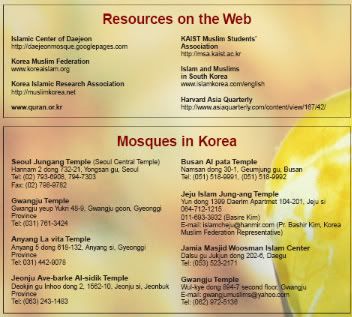
Islam in Korea

This is the fifth in a series looking into religion in Korea from a community perspective. The first objective is to give expatriates a springboard from which to develop spiritually. Feature articles will have examined Christianity, Buddhism, Hinduism, Judaism, Islam and Sikhism. - Ed.

When people think of Korea and religion, most assume it's a land of only Buddhists temples and Confucian values. However, as the other articles in this series have shown, other religions are very active here.

Some might be surprised to hear that Islam is present and actively practiced here. One reason is because of the frequent confusion of the terms "Muslim" versus "Arab." Muslim refers to anyone who practices Islam. Muslims can be from any number of nations or regions like Turkey, Iran, Iraq, Pakistan, Malaysia, Indonesia, China, as well as countries in Europe, Africa and the Americas. In contrast, Arab is a term that refers to people from the Arabian peninsula and who speak the Arabic language.

However, someone who is Arab is not necessarily a Muslim.

Photo by Matthew Lamers

Historically, Muslims and Koreans have been in contact for hundreds of years. This contact came through China and via trade. But an active Korean Muslim community started developing in South Korea after the Korean War, due to the presence of Turkish troops who had fought in the war and their presence in the United Nations forces after the armistice.

Since then, the Korean Muslim community has slowly grown.

Originally, this piece was supposed to appear earlier in the series but my interviewee, Haseeb Ahmad Khan, had to travel for a bit of time. He and I touched base earlier this month. Here is what he had to say about Islam not only in Busan, where he lives, but in all of South Korea.

Haseeb is originally from Pakistan, but has lived in South Korea for almost 10 years. He is married to a Korean national and has an export business located in Busan. Haseeb started off the interview by explaining that people who practice Islam have to pray five times a day.

In most cases, he explains that, "They offer their prayers in their offices or their workplaces," because it is too difficult for them to come to the mosque. However, he added that if they are close enough, the mosque is where they ought to pray. Those who cannot, observe their prayers at work. He added that: "On Friday we get together in the mosque."

"Jummah is the Friday prayer," and there are names for the other prayers too. He said there is a social purpose to gathering at the Busan mosque on Fridays.

"The Friday prayer is to unite the people. After the prayer they can unite to make a better community. ... They can talk and they can listen. For example, if someone is sick, they can arrange to go to the hospital - or, if they find out that someone needs help, they can arrange to help."

He explained that both men and women have these meetings. Their prayer rooms, as well as the subsequent meetings, are separate. When asked to describe the people who come to the mosque to pray he said, "(W)e have a few Koreans. We have Indonesians, Malaysians and Uzbeks. We have people from the United States. We have people from 12 to 14 countries."

Why did he become so active in the Muslim community?

"I'm a Muslim. This is our religion. Wherever we go, we have to practice our religion. When I came to Korea, they didn't have a lot of mosques in Korea. Now we have a lot of mosques in Korea. At first, I was in Seoul and people got together at the Itaewon mosque. Then I moved to Busan for work and now I worship in a mosque in Busan."

This also applies to Muslim schools.

"We're trying to open a small school in Busan. ... (For) people who are married ... they have kids to raise and they have to teach them a Muslim education. We have schools in Daegu and Seoul."

In addition, for those who are curious about Islam, Haseeb said that they have services and resources for people who want to learn more.

"Yes, they can come to the mosque. We have - the head of the mosque, an Imam (the Muslim equivalent of a priest) in the mosque. If they want some information we have a library in the mosque.

"They can get these things for free."

In their library, they have reading materials and audio materials that people can borrow and use.

Haseeb was very eager to explain that the Muslim community is very active in helping those seeking information on where to worship. "We have a system where people can ask for a mosque and anyone can tell you where the mosque is. We also have a website for the Busan mosque."

On this site people can find information on Islam in Busan.

"The mosque in Busan is near Dushil Station."

Mosques are now in various locations throughout the country. "We have more than 10 mosques in cities like Gwangju, Busan, Daegu."


Here is the Adobe Acrobat, .pdf, version of the page for you to read, if you like: KH03242009

Read More...

Sphere: Related Content

Friday, March 6, 2009

DJ Nakadia

In my mad rush to get on the plane on Friday, I completely forgot I had a piece in The Korea Herald that day. I did an interview with a Thai DJ named, Nakadia. She was scheduled to spin Friday night and I'm sure it was great. I was excited about this one because it's mostly men you see doing the international, touring DJ thing. Also, I went to her MySpace page and there are some great mixes there. She's good.

All of the interview didn't make it to the paper, but I'll post it in its entirety here when I get the .pdf from my editor. Enjoy!

DJ Nakadia Spins in Seoul Tonight

When you Google "DJ Nakadia," the first thing you notice is that she's a successful female in a male-dominated profession. There are very few women who make a living DJing full-time, much less make a living as a globe-trotting DJ.

Nakadia's home club, Club Mint, is on the island of Koh Samui in her native Thailand. Since she started spinning in 2003 she's emerged as the top international DJ coming out of Southeast Asia. Knowing all this about her and learning that she'll be appearing in Seoul tonight at Club Vera in Hongdae makes it an exciting opportunity for expats in and around Seoul that are into the club scene.

Expat Living: I read that you developed an interest in DJing when you were in Europe. Please tell me that story. When did you decide to DJ? Why electronic? How did you learn to DJ?

DJ Nakadia: On my first trip to Europe my friend took me to a club and I saw a female DJ spin. I loved it so much and I knew from that moment that this is what I had to do. It was not a dream, but more like my destiny.

EL: I was really excited to get the chance to interview you because you're a female DJ. In what ways can this be bad or frustrating?

DJ Nakadia: In my case it is actually bad. Many of the best clubs in the world did not want to book me in the past because they looked at me as just one of these girls that play commercial records and cannot really mix. Over the last year that started to change when many people heard me live and now they accept me and book me. It is frustrating if people just go after the looks - that has nothing to do with my art at all.

EL: In addition to having a home club, Mint Club, on Koh Samui, you are an international DJ. How many countries have you been to?

DJ Nakadia: I only stay in Samui about 15 weeks per year to get some rest from the tours, but at the moment I play so much that I cannot relax at all. Soon my tour will start again and I will play 37 countries this year. So far I have played in 43 countries over the past three years.

EL: What's the great part about being a traveling DJ? What's the not-so-great part?

DJ Nakadia: By touring around the world I really learned so much about music and how to read people and make the party a success. It took me over 300 gigs around the world to be the DJ that I am now. I am happy I got this chance. The bad part is that I get very tired of the flying now. Sometimes I wish I could just stay in one city for a week or just a few days.

EL: You were the DJ picked to play at the 2006 World Cup Finals in Berlin. What can you tell us about that? How did it feel to DJ for an audience from all over the world?

DJ Nakadia: It was very exciting just to be there and get a chance to look behind the scenes. I was supposed to play together with Sven Vath and in the end I only had seven minutes on stage. But it was really great after all.

EL: You've also DJed for the Love Parade in Berlin before. Can you describe that for those who haven't been there?

DJ Nakadia: Loveparade is the biggest event you can imagine. It was always great, but the last one in Dortmund was a lot more than just a parade. The six-hour closing party was just unbelievable. It was also broadcasted live around the world. It is the most exciting feeling to play for nearly 2 million people!

Go to www.nakadia.com to learn more about DJ Nakadia. To get ticketing information on tonight's event, please either e-mail seoulvibes@gmail.com or go to www.myspace.com/seoulvibes.

Here is the Adobe Acrobat, .pdf of the article:
KH03062009

Here is the entire interview - some just didn't make it to the piece.

1. Is this your first time spinning in Seoul or have you been here before?

Actually I played my first international gig in Seoul, which was in 2003. After I was back again in 2005 and this will be my third time in your city.

2. If you’ve been here before, what’s your impression of the DJ and club scene in Seoul?

I am hearing amazing things about Seoul it is becoming one of the biggest clubbing capitals of Asia. I am impressed and really curious about the city this time.

3. What’s your favorite club city?

Berlin – I think there is no second city like Berlin. Some clubs open sixty hours nonstop on the weekend and the best DJs in the world play there all the time – it is really exciting!

4. I read that developed an interest in DJing when you were in Europe. Please tell me that story. When did you decide to DJ? Why electronic? How did you learn to DJ?

On my first trip to Europe my friend took me to a club and I saw a female DJ spin– I loved it so much and I knew from that moment that this is what I had to do. It was not a dream, but more like my destiny.

5. How would you describe the music you play to people who’ve never heard you and to people not really familiar with the club scene?

Every night I play different sets and I always try to understand the vibe and the people of the club. I want to make them feel happy playing music they can understand and then slowly I want to bring them to the music that I want them to hear- Nakadia style! I cannot explain my music. You have to feel it. It is at the same time deep and emotional, but uplifting and powerful as well. You really have to be on the dance floor to understand it.

6. I was really excited to get the chance to interview you because you’re a female DJ. In what ways is being a good-looking female good for what you do? In what ways is it bad or frustrating?

In my case it is actually bad. Many of the best clubs in the world did not want to book me in the past because they looked at me as just one of these girls that play commercial records and cannot really mix. Over the last year that started to change when many people heard me live and now they accept me and book me. It is frustrating if people just go after the looks – that has nothing to do with my art at all.

7. In addition to having a home club, the Mint Club, on Koh Samui in your native Thailand, you are an international DJ. How many countries have you been to?

I only stay in Samui about fifteen weeks per year to get some rest from the tours, but at the moment I play so much that I cannot relax at all. Soon my tour will start again and I will play 37 countries this year. So far I have played in 43 countries over the past three years.

8. What’s the great part about being a traveling DJ? What’s the not so great part?

By touring around the world I really learned so much about music and how to read people and make the party a success. It took me over 300 gigs around the world to be the Dj that I am now. I am happy I got this chance. The bad part is that I get very tired of the flying now. Sometimes I wish I could just stay in one city for one week or just a few days.

9. How has the Internet helped you develop a following as a DJ?

Absolutely! Without the internet my success would not be possible. Now there are thousands of people around the world that follow me on the net and when I play somewhere there are always facebook or myspace friends who come to party with me. The world is a village these days because of the net.

10. Are there many good DJs in Thailand? If so, who are some of your peers?

Music wise Thailand is very far behind the rest of the world. There are a few Thai DJs who really play well, but nobody cares much and they play mostly for empty rooms. I am very lucky to have such a big following in my own country, but until last year I also did not get a chance to play much in Thailand.

11. You were the DJ picked to play at the 2006 World Cup Finals in Berlin. How can you tell us about that? Was it exciting? How did it feel to DJ for an audience from all over the world?

It was very exciting just to be there and get a chance to look behind the scenes. I was supposed to play together with Sven Vath and in the end I only had seven minutes on stage. But it was really great after all.

12. You’ve also DJed for the Love Parade in Berlin before. Can you describe that to someone who hasn’t been there? (Ich sprechen ein bishen Deutsch und I hatte nach Berlin während des Sommers gewesen. my german is rusty!!!)

Loveparade is the biggest event you can imagine. It was always great, but the last one in Dortmund was a lot more than just a parade. The six hours closing party was just unbelievable. It was also broadcasted live around the world. It is the most exciting feeling to play for nearly 2 million people!

13. British music guru, Eddie Gordon, has said some great things about you and went as far as calling you the Madonna of the DJ scene How does it feel to get such positive reviews and feedback?

Of course it makes me very happy when people write nice things about me, but to hear something like this from Eddie Gordon was a very big shock. I remember that I had tears in my eyes at the time. This was four years ago and at that time I did not really understand what he meant. I was just a very normal DJ and did not think I was unique. Everything is changing so quickly and it such an exciting time for me. Somehow it seems Eddie knew this would happen.

14. I’m black American, and I found an article where you were interviewed about colorism in Thailand. You said the Thai media has not been enthusiastic supporters because you’re a darker skinned Thai. Do you think that’s changing as you become more successful? Do you think the election of a black American president will make people think twice about discriminating based on race and skin tone?

Unfortunately, Thailand has not really developed much in this area. Dark skin is still a sign of second class people and nobody wants to support that. At the moment I see no change. When the whole world was excited when Obama was elected, I did not see any excitement in Thailand at all. This is something that makes me very sad. And I hope that one day my country will change also.

15. I read that you have a reality TV show in the works. Can you tell us more about it?

The people from Loveparade produced a feature about me to broadcast during the TV show of Loveparade. When we worked on that feature, the producer came up with the idea for a reality show about me. We had many meetings with different production companies about this idea and now everything is ready to go.

16. I read that you’re producing now. What sort of projects are you working on?

I have had many releases so far and worked with different studio partners. At the moment, I try to come up with a new idea every week and later when I am in Berlin I will work out some of these ideas. I hope to release at least six tracks and some remixes this year.

17. I noticed that on the Underground Bangkok Radio website you’re listed as one of the top 10 downloaded DJs. How does that make you feel? Also, where else can people download or buy your mixes?

I have a few websites where I upload my live mixes. Most mixes get a few thousand downloads and sometimes the websites get the most downloads. This always makes me happy because it shows that people really like my music, even if they have not seen me spin live.

My favorite Dj-mix website is www.darkaudio.co.uk – all my mixes can be found on this site.

Read More...

Sphere: Related Content

Monday, February 2, 2009

[Regina Walton's Expat Interviews] Judaism in Korea

My time here is rapidly winding down and I think of these religion pieces as a contribution to the well being of expats living here in Seoul. I say Seoul because, unfortunately, all of my interviewees thus far are Seoul-based and have Seoul-based congregations.

Here is part four: Judaism in Korea

This is the fourth part in a series looking into religion in Korea. The first objective is to give expatriates a springboard from which to develop spiritually. Feature articles have examined Christianity, Buddhism, Hinduism, Judaism and will examine Islam and Sikhism. - Ed.

When you think of religion in Korea, Judaism does not exactly spring to mind.

But over the last decade especially, Seoul has seen demand for Jewish products and food rise, and in 2008 the Chabad House opened in the Itaewon district of Seoul.

This was a significant event for Judaism in Korea. There are quite a few Christian and Muslim services available to foreigners, but there was nothing for Jews.

If you weren't associated with the military and you're Jewish, you had had to arrange for someone to sign you in to a U.S. military on base.

Chabad House opened in Seoul in April 2008, and they offer services to help Jews living in or visiting Seoul.

Like other religions, there are different strains of Judaism: Orthodox, Conservative and Reform. Chabad-Lubavich is Orthodox. It was founded in Russia in the 18th century and is now based in Brooklyn, New York. In the 1950s they started to send shluchim, or missionaries, around the world in order to reach as many Jews as possible. Currently, Chabad-Lubavich has over 3,000 centers worldwide.

I had a chance to meet with Rabbi Osher Litzman at his home to ask him a few questions about Chabad House and how the transition has been for him, his wife and their family.

"Chabad is a home away from home for every Jew, whatever his or her background." When asked what Chabad House provides for people in need, Litzman answered, "You can come talk to a Rabbi, get kosher food, get religious materials for the holidays, participate in events, practice Judaism and learn more. This is all about having one place to come, to feel more connected and to meet other Jews."

Rabbi Osher Litzman (right), from Israel, is the Jewish leader of the Jewish community of Korea. Pierre Cohen-Aknine is originally from France and has been living in Korea for the last 27 years. [Photo by Jung-keun Song]
Litzman then explained the current schedule for Jewish services: "We have services every Friday night, every Saturday morning and afternoon, and on holidays. Sometimes we have services during the weekday as well." The schedule can be found at Chabad of Korea website (jewishkorea.com).

They are also establishing other regular events, like the Tefillin Club, which is a place for men to come, enjoy and relax and have kosher food. They meet on the first Sunday of each month at the Seoul Cigar Club.

They also have a similar gathering for women. The women's gathering is based on the Jewish calendar and is scheduled near Rosh Chodesh, the first day of the Jewish month.

Litzman added that there are plans in the works to create regular activities for children.

So what exactly does "kosher" mean? "Kosher means that the production of the food has been supervised and does not violate Jewish dietary laws," said Litzman.

He then explained that people who are in search of kosher food in Korea are lucky because Costco actually stocks many kosher food items. "(On) kosher (foods) there is a symbol that means that someone inspected the manufacturing process and found it in accordance to Jewish dietary laws ... Korea is blessed with Costco. Costco has many kosher products except for milk, cheese products and meat.

"We produce kosher cheese ourselves, but it is still a problem to obtain kosher meat. We have to find a good solution for that."

When asked to describe Chabad's regular congregation he said, "Every week we find at least one more Jew. Hanukkah was two weeks ago and it was a wonderful time. Many new people came to the event we had in front of the Hamilton Hotel. People saw us building the Menorah."

Right now there isn't a demand for it, but the rabbi did not rule out the possibility of a Chabad House one day opening in a location outside Seoul. "Well, there are not many Jewish people who come here to tour. This is most likely because there are no kosher options here.

"In Beijing, they have a kosher restaurant. In Thailand they have kosher restaurants. All over the world they have kosher restaurants, but not here. We just opened. There are direct flights between Israel and Korea, but I think we've had fewer than ten tourists since we opened."

He explained that most people they work with are here as expatriates. Also, "(we) have business people coming in from all over the world. All of them have said that they would not stay here for the weekend if we were not here."

The response from the Jewish community has been both positive and strong. "The request for us to come was from the community ... Many Jews that live and work here didn't have a place to pray for Yom Kippur."

Now that Chabad is here, Rabbi Litzman can help Jewish families become more observant. "Now people have the opportunity. We have a family that decided to keep kosher. We kosherized their kitchen."

He then went on to describe how Jews in Seoul are now able to follow Jewish traditions more easily now that they are here. "Another (member has decided) to put on the Tefillin, leather boxes which contain biblical verses and are very important for prayer rituals every day - not only one, but a few. Some people bought Tefillin and some people had it before and now they're using it.

We are giving people Mezuzot." Mezuzot are hand-written biblical verses put on doorways that he described as not only Biblically commanded, but also a kind of method Jews use for home security.

"People are getting books and we have lecturers." These lectures usually occur at the same time as the Friday and Saturday services. "We are about to establish a library. We want to open a Jewish library here in Korea. We are requesting donations for books."

In terms of upcoming special events, he mentioned that they will be bringing in rabbis from other locations in Asia and from around the world.

"Korea is the best place to live. You get a taste of everything. You can feel that you live in America sometimes. You have modern technology and a nice subway. (It's) better than New York even.

"Wonderful people live here. We have gotten so much help from so many people and they didn't want a penny."

For more information on kosher meals, synagogue services or classes please go to the Chabad-Lubavich Korea website: jewishkorea.com

For information on the Tefillin Club go to jewishkorea.com/Teffilin.html

Here is an Adobe Acrobat version: KH01162009

Enjoy!

Read More...

Sphere: Related Content

Wednesday, January 21, 2009

[Regina Walton's Expat Interviews] Hinduism in Korea

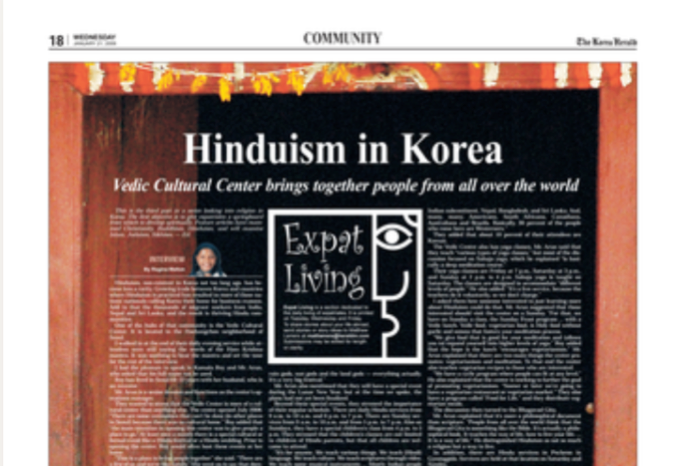
Here is the third part on religion in Korea.

Screengrab of the Article From The Korea Herald

Hinduism in Korea


This is the third part in a series looking into religion in Korea. The first objective is to give expatriates a springboard from which to develop spiritually. Feature articles have examined Christianity, Buddhism, Hinduism, and will examine Islam, Judaism, Sikhism. - Ed.

Hinduism, non-existent in Korea not too long ago, has become less a rarity. Growing trade between Korea and countries where Hinduism is practiced has resulted in more of those nations' nationals calling Korea their home for business reasons. Add to that the thousands of migrant workers from India, Nepal and Sri Lanka, and the result is thriving Hindu communities.

One of the hubs of that community is the Vedic Cultural Center. It is located in the Haebangchon neighborhood of Seoul.

I walked in at the end of their daily evening service while attendees were still saying the words of the Hare Krishna mantra. It was soothing to hear the mantra and set the tone for the rest of the interview.

I had the pleasure to speak to Kamala Roy and Mr. Arun, who asked that his full name not be used.

Roy has lived in Seoul for 12 years with her husband, who is an investor.

Mr. Arun is a senior devotee and functions as the center's operations manager.

They wanted to stress that the Vedic Center is more of a cultural center than anything else. The center opened July 2008. "There are some ceremonies that can't be done (in other places in Seoul) because there was no cultural home." Roy added that "the main intention in opening this center was to give people a place to go." At least once a month there is a special cultural or formal event like a Hindu festival or a Hindu wedding. Prior to opening the center, Roy would often host these events at her home.

"This is a place to bring people together" she said. "There are a few of us and we're like family." She went on to say that doesn't just apply to people from India, but it's also for people from Nepal, Bangladesh, Pakistan and Sri Lanka.

They started off by letting me know about their scheduled Pongal celebration, which happens on Jan. 13, 14 and 15, but the center celebrated it this past weekend on Jan. 18. The celebration is based on the Hindu Lunar Calendar. "It's like our Thanksgiving Day ... This is the season where we get back the harvest to the home. Getting the harvest to the home is like money coming to the home. That's why we give thanks to the rain gods, sun gods and the land gods - everything actually. It's a very big festival."

Mr. Arun also mentioned that they will have a special event during the Lunar New Year, but at the time we spoke, the plans had not yet been finalized.

Beyond these special events, they stressed the importance of their regular schedule. There are daily Hindu services from 9 a.m. to 10 a.m. and 6 p.m. to 7 p.m. There are Sunday services from 9 a.m. to 10 a.m. and from 5 p.m. to 7 p.m. Also on Sundays, they have a special children's class from 4 p.m. to 5 p.m. They stressed that the children's classes are not limited to children of Hindu parents, but that all children are welcome to attend.

"It's for anyone. We teach various things. We teach (Hindi) language. We teach culture. We teach scriptures through video. We teach some musical instruments ... Mostly Indian people come, but people have a wrong notion that it's just for Indians.

"We have Korean children also. ... We've designed a course which changes every weekend so that the children don't get bored." Roy added that they teach language. "Also, we teach them the Indian alphabet because there is Indian school (in Seoul)."

When asked to describe the center's attendee's, Mr. Arun explained that there are people from all over the world who attend. "We have people from India, Pakistan, and basically the Indian subcontinent, Nepal, Bangladesh, and Sri Lanka. And, many, many, Americans, South Africans, Canadians, Australians and Brazils. Basically, 30 percent of the people who come here are Westerners."

They added that about 10 percent of their attendees are Korean.

The Vedic Center also has yoga classes. Mr. Arun said that they teach "various types of yoga classes," but most of the discussion focused on Sahaja yoga, which he explained "is basically a deep meditation course."

Their yoga classes are Friday at 7 p.m., Saturday at 3 p.m., and Sunday at 2 p.m. to 4 p.m. Sahaja yoga is taught on Saturday. The classes are designed to accommodate "different levels of people." He also added: "It's a free service, because the teachers do it voluntarily, so we don't charge."

I asked them how someone interested in just learning more about Hinduism could do that. Mr. Arun suggested that those interested should visit the center on a Sunday. "For that, we have on Sunday a class, the Sunday Feast program ... with a Vedic lunch. Vedic food, vegetarian food, is Holy food without garlic and onions that fosters your meditation process.

"We give food that is good for your meditation and (allows you to) expand yourself into higher levels of yoga." Roy added that the hope is the lunch "encourages vegetarianism." Mr. Arun explained that there are two main things the center promotes: vegetarianism and meditation. To that end the center also teaches vegetarian recipes to those who are interested.

"We have a cyclic program where people can fit at any level." He also explained that the center is working to further the goal of promoting vegetarianism. "Sooner or later we're going to have a vegetarian restaurant or vegetarian market." They also have a program called "Food for Life," and they distribute vegetarian meals.

The discussion then turned to the Bhagavad Gita.

Mr. Arun explained that it's more a philosophical document than scripture. "People from all over the world think that the Bhagavad Gita is something like the Bible. It's actually a philosophical book. It teaches the way of life, how to live your life. ... It is a way of life." He distinguished Hinduism as not so much a religion but a way to live.

In addition, there are Hindu services in Pocheon in Gyeonggido. Services are held at that location on Saturday and Sunday.

You can find more information on The Vedic Center, including contact information at krishnakorea.com, e-mail koreakrishna@gmail.com, phone 010-2448-6441. Please contact the Vedic Cultural Center for information on their Lunar New Year event.


Here is a .pdf.: KH01212009. Enjoy!

Read More...

Sphere: Related Content

Tuesday, January 13, 2009

[Regina Walton's Expat Interviews] Buddhism in Korea

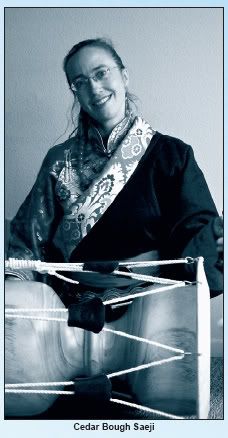
Here is the second in the religion series my editor, Matt Lamers, and I are working on. Even though I'm credited as the writer on this piece, Matt added quite a bit on Cedar Bough's approach and practice of Buddhism.

In the name of full disclosure, Cedar Bough has been a friend of mine pretty much since I arrived in Korea. When I got this column, I told her then I wanted to interview her because what she achieved while being here and what she's working on now is truly impressive. However, I didn't have a chance to talk to her one on one until I was home in L.A. last September.
________________________________

Buddhism in Korea

This is the second part in a series looking into religion in Korea. The first objective is to give expatriates a springboard from which you can develop spiritually. Feature articles will examine Christianity, Buddhism, Islam, Hinduism, Judaism and Sikhism. - Ed.

At times being a foreigner in Korea can be a little challenging. There is both an immense language barrier and a cultural barrier. But once you get past the culture shock, both can be overcome. Cedar Bough Saeji is a good example of a foreigner who has successfully managed to immerse herself in both the language and culture of Korea.

One of the ways she did that was through the practice of Buddhism.

"I feel that I became much stronger in my practice after moving to Korea, and specifically I found the Korean Jogye Order's way of practicing Buddhism to meld nicely with the various things in the tradition that I had picked up on," she said.

If you're interested in meeting other Buddhists, but you do not speak Korean fluently, Cedar Bough recommends visiting one of the country's many temples. "There are temples everywhere in Korea; if you go to one, you can expect to meet other Buddhists. You don't need to speak Korean, you just need to be respectful and observe temple etiquette. If you just do that, they'll like you already."

She also talks highly of temple stays. If expats are seriously interested in Buddhism, she recommends going on a temple stay program at a remote temple. She says it's cheap and proper instruction is provided on how to participate in the ceremony and temple etiquette.

"In Seoul there are Dharma talks advertised in the religion section of the newspaper, in English. There are also some temples that are being run by foreign-born abbots, or abbots that speak good English. If you contact the Jogye Order they will put you in touch with everything you need," she said.

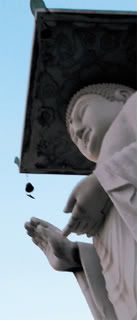
The Buddha stands tall at Bongeunsa, Gangnam-gu, in Seoul.[Photo by Matthew Lamers/The Korea Herald]

What is it about Buddhism that appeals to her?

"Everything, really. My favorite sutra is perhaps that of Vimalakirti, reading it is out of this world - Thurman's translation is supposed to be the best. I like impermanence and reincarnation - I like that I can keep improving myself through multiple lifetimes. I'm not a meditator. A lot of Westerners think of Buddhism and they immediately think of sitting meditation. That's not for me," she said.

"But I love bowing, prostrating, chanting. Right now, working on my Ph.D., I feel very connected to Manjusri. It can be hard to explain but I feel the rightness of Buddhism inside of me as I practice. I took a three month dedicated Buddhist pilgrimage, and I visit a lot of Buddhist sites as part of less Buddhist focused travels - most of the major sites in Asia, actually. It's also important to me that Buddhism does not negate the truth in other doctrines/religions - it is not dogmatic."

Regarding English accessibility, she said you probably won't find good Dharma talks in English near your home, "but there may be a nearby temple. I suggest that you read up on Buddhism at home and go to the temple for the uplifting feeling you get when you start the day with 108 bows."

I met Cedar Bough seven years ago. We were both busy with our own things here but ended up in graduate school at international studies programs across the road from each other. I was at Ewha Womans University and she was at Yonsei University. Now she's in Los Angeles pursuing her doctorate at UCLA.

Cedar Bough first arrived in Korea in 1996. Her reasons for coming to Korea sound similar to others who've come: She wasn't particularly interested in Korea, but had a goal of paying off student loans and a desire to see the world. "I had no special reason to come to Korea. I had no special previous knowledge of Korea or interest in Korea. So, until I showed up, Korea was basically a blank slate for me ... I found that I really loved Korea and I felt like it was my fate to come to Korea and that I had been led to come to Korea for a reason because I felt everything about Korea, even the air, which some people may complain about, even breathing in the air made me feel like I was at home.

"There was a tremendous feeling of comfort in Korea that I felt like I hadn't experienced in other places. So from the moment I arrived in Korea I really knew it was a good place for me to be. Korea has almost always treated me very well, so I have had all these amazing experiences and a lot of stuff has led me to want to stay there."

She left for a year in 2003 and spent time in China. There she was reunited with her then-fiance, now husband, Tibetan musician Karjam Saeji. After spending a year in China, she came back to Korea and enrolled in Yonsei's Graduate School of International Studies. There she earned a master's degree in Korean Studies with a focus on Korean culture, society and religion.

"I realized I really enjoyed academia and that I wanted to perhaps have a future in academia," she said.

However, after Yonsei she took a year off to take a pilgrimage from Eastern Tibet to Lhasa with her husband. Because her Ph. D. focuses on Korean performance arts, when finished, she'll have a doctorate in culture and performance with a focus on Korean folklore.

"Most particularly, I like the Korean mask dance dramas, but all folk performance arts are interesting to me, even court arts are fascinating. Preservation of traditional culture has to be done in the right way so that it's not turned into a reenactment, but is still part of Korean consciousness. I become quite distressed when I see how little younger Koreans - and I can't blame very young Koreans, but college age Korean students - know about Korean traditions. Typical Korean college students may know a little about traditional Korean culture, but maybe they can't even tie the bow on a hanbok."

Cedar Bough is a great example of how an expat can learn more about Korean culture and the language. Her advice to others who want to learn more is pretty straight forward: "In general, if Koreans see a sincere desire to learn about Korean traditions then the people that know about them are very happy to teach foreigners. When you sometimes get a sense that Koreans don't want to teach you about something traditional, it is generally when they've run into the limit of their own knowledge and they're embarrassed. Because how embarrassing is it to have a foreigner interested in something about your own culture that you do not know? So people will shut down and give a foreigner a feeling of being closed out."

She then talked about specific places in Seoul where expats could learn about Korean arts and culture. She said one of the best ways for expats to get a taste is at the National Center for Korean Performing Arts. Twice a year they run free, or low fee, classes that give expats a chance to learn gayageum, or janggu. "It's a good way to get an initial idea if you'd be interested in taking it further. It is free and it is on the weekends. There are actually hagwon for Korean traditional dance and music."

She said city governments run cultural and educational programs. She added that, while there might be a language barrier for a lot of these classes, you can listen, watch, follow along and still learn.

If you're interested in getting deeper into Buddhism, Cedar Bough said that you should stick with the same temple, so that people get used to your presence. "I think that foreigners should know that if you go and practice respectfully in Korea, in the course of only a few visits to a temple ... people will get used to you and welcome you. It will take longer if you skip around and come to different services at different temples, of course. If you live in Seoul, you should go to the 4 a.m. service at Jogyesa at least once. During my M.A. in Seoul and now every summer when I visit Korea for research I go there as often as I can.

"If your own learning has only taken you so far and you really want to go deeper, there are retreats at several temples, including ones run in English, you can get more information at seoulzen.org about those."


Here is a .pdf version of today's page: KH01132009

Read More...

Sphere: Related Content

Thursday, January 8, 2009

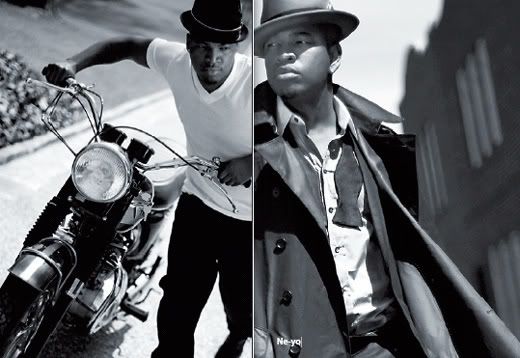
[HERALD INTERVIEW]Ne-yo back in Seoul with Jamsil show

Ne-yo will be in town in concert this weekend. Thanks to the promoter, XStream Productions, I managed to land another interview scoop.

This time, however, the culture section demanded it be moved from the Expat Living section to theirs. Um, okay. Maybe not the coolest move on their part, but a scoop nonetheless. Only now it's bumped up a few pages.

Here is the interview. Enjoy.

[HERALD INTERVIEW]Ne-yo back in Seoul with Jamsil show

On Jan. 11, Seoul's R&B fans will have something to celebrate. As he promised last year, Grammy Award winning, R&B singer and producer Ne-yo will be back to perform.

Fans in Seoul got their first taste of him live last April when he performed at Olympic Stadium. This weekend Ne-yo will perform at Jamsil Gymnasium, along with pop group the Pussycat Dolls.

Ne-yo is on tour to promote his third album, "Year of the Gentleman." His 2008 release was recently nominated for six Grammy Awards. The album was inspired by the smooth style of crooners such as Frank Sinatra and Sammy Davis, Jr.

This time, however, there won't just be a concert. X Stream Productions will host a public after party at 10 p.m. featuring a special appearance by Ne-yo at Club Answer in Seoul. Hip-hop artist Carlos Galvan, aka Cali-Mexci, will be the master of ceremonies.

Ne-yo started writing songs for popular music acts in the late 1990s. He was thrust into the limelight after he co-wrote Mario's hit single "Let Me Love You." After the success of that single, Ne-yo's celebrity grew and he is now an established writer.

In an email interview, Ne-yo talked about making songs and artists he's worked with, and offered advice for emerging musicians.

Q: You started off as a performer but got your break as a songwriter when Marques Houston recorded your song "That Girl." How does it feel to now be both a songwriter and popular performer?

A: My first major placement was with Marques Houston, but that's not all. I wrote a song called "Bad Girl," after that it was Nivea, Christina Milian, then B2K, Heather Headley. Then it was the Mario, Mary J. Blige, Faith Evans, Musiq Soulchild, Ruben Studdard, Paula DeAnda, some more stuff for Christina Milian, Beyonce, Rhianna, Mario Vazquez, Megan Rochelle ... I know I'm forgetting people - Britney Spears, Whitney Houston, Jennifer Hudson, Celine Deon, Usher, Chris Brown - and on and on.

Q: You also have a strong reputation as a producer of hit records. For example, you produced Rihana's "Take a Bow" and Beyonce's "Irreplacable." How does it feel to have such great success as a songwriter, producer and performer?

A: It's like this - if my song falls at number three, and a song I wrote for Beyonce falls at No. 2, and a song I wrote for Mary J. Blige falls at No. 1, I'm still the first three, so it's all good to me. One, two, and three is still me, even if it ain't me as an artist, it's still me. My name is still on the first three slots in the Billboard charts, so I'm good.

Q: Can you name some of your favorite artists? What artists and songs are in rotation on your iPod?

A: My choice for this year has got to be Lil Wayne. Wayne had a fantastic year in 2008. Wayne has been dope for a really, really long time, and people are just starting to notice it. Jazmine Sullivan, newcomer to the game, did really big things this year. Katy Perry, another newcomer to the game, did really big things this year. There was a lot of really good music this year.

Q: Can you name some of the artists you've loved working with?

A: All artists are unique and I love working with various artists so that I can try out different styles, and as I've mentioned, I have worked with many artists.

Q: You were baptized as Shaffer Chimere Smith. How did you get the name Ne-yo?

A: Everyone asks me that and most everyone knows that I got called Neo by Big D Evans cuz he said I saw music like Neo from the Matrix. Then all of a sudden everyone started calling me that.

Q: You have a recording studio in Atlanta, Georgia, called Carrington House and your own production company called Compound Entertainment. Do you want to start your own record company like Babyface's LaFace Records? Would that also be based in Atlanta?

A: Compound is a label and some artists associated with it are Paula Campbell and Sixx John and Shanell.

Q: According to reports you're also going to work with Marilyn Manson. He performed in Seoul at the ETP Festival over the summer. How is your collaboration with him going?

A: You'll have to wait and see!

Q: Finally, what advice would you give to those aspiring performers, songwriters and producers?

A: I say what I always say, hone your skills. Take the time to hone your skills. A lot of what the business is today is meeting the right person at the right time. You've got to establish relationships and connections. Somebody's going to hear your music at some point - someone's going to find out about it. So you've got to be ready for when your opportunity comes. When I met with Def Jam I hadn't planned on auditioning for them. But the deal happened because I had the songs and I was ready to perform.

For more information on the after party contact Club Answer at (02) 548-7115 or go to their website at www.clubanswer.co.kr. For more information on the concert, go to ticket.interpark.com or call 1544-1555. Learn more about Ne-yo's music at his website www.yearofthegentleman.com


Here is a .pdf version:

KH01162009

Read More...

Sphere: Related Content

Tuesday, December 23, 2008

[Regina Walton's Expat Interviews] Christianity in Korea

Unless something significant happens, I'm on my way home in the next couple of months. However, I've wanted to do a series on religion pretty much since I started this column.

The first in this series was published today. My goal is to just give a bit of information on the people who help us out spiritually. I've never been much into the party scene here, which consists of drinking to excess and a so-so bar and club culture. However, most of the major religions are here and have houses of worship.

I've started with Christianity simply because it's the day before Christmas, but we'll cover as many as we can including, but not limited to, Buddhism, Judaism, and Islam.

Christianity in Korea

This is the first part in a series looking into religion in Korea. The first objective is to learn about the lives of the expatriate clergy. The second is to give expatriates a springboard from which to develop spiritually by providing the contact information and service times for their religious services. Feature articles will examine Christianity, Buddhism, Islam, Hinduism, Judaism and Sikhism. -- Ed.

In the expatriate community it's easy to find a group of friends to drink and party with. However, it can be more of a challenge to establish a spiritual sense of belonging.

Pastor, missionary, scholar Reverend Paul Mooney English-language Ministry at Seoul Cathedral

Reverend Paul Mooney, from Dublin, Ireland, describes himself as a "city boy and a Dubliner at heart," because he was born and raised there.

He first came to Korea in August, 1980 and stayed until 1982. At that time, he was a theological student doing his missionary training in Korea. He had been studying with a Roman Catholic organization called The Columban Fathers at their school in Ireland -- St. Columbans. During that time, he studied the Korean language at a language institute named Myongdowon, which no longer exists.

When asked when he decided to become a reverend, he quickly corrected the question, saying, "I don't know whether people actually decide to become a reverend or if something decides them to become one."

What brought him to the church?


A crucifix at the Seoul Anglican Cathedral [Photo by Matthew Lamers/The Korea Herald]

"For me, it really goes back to the time I was a teenager and I started to feel some way attracted to becoming a priest, for want of a better word ... specifically a missionary. So I suppose, I've had that kind of leaning since I was about 16.

"For me, the funny thing is, I'm actually living half a mile from where I lived in 1980, and I'm working sort of half a mile from where I studied in 1980."

He explained that he came back to Korea after all these years because in his heart, he is more of a traveler. When he left Korea, he was Chaplin of the Mission to Seafarers in Busan. After he left Busan he was in the same ministry in Brussels, Belgium. After Brussels, he returned to a parish in Ireland.

"What attracted me to come back? Well, I was looking through the job section of the Church Times website one day, and I saw they needed a chaplin for the English congregation in Seoul."

He said he had visited York Cathedral a year or two earlier. "It was somebody that had died and it said 'pastor, missionary, scholar' on his (epitaph). I said 'that's what I want to have on mine.' So this kind of makes that possible to do what I feel is my own calling.

"I knew I was ready. The job was there and the job was open. I came over and interviewed and it worked. I'm very, very happy. It's one of the most satisfying experiences I've had, ministering with the foreign congregation here."

He explained that "the word Anglican basically means English, so Anglican Churches are churches that derive in some way or other from the Church of England.

The Anglican Church is located in downtown Seoul beside the British Embassy, across from City Hall. The services Mooney presides over are in English. The Eucharist service is every Sunday at 9:30 a.m. in the church's crypt chapel, which is downstairs from the main chapel. On Sunday at 5 p.m. there is the Evening Prayer.

The church has a Bible study for adults after the main Eucharist service. He added that the church has Sunday school for children. For readers who are not in Seoul, but are interested in Anglican/Episcopalian services, there are English speaking services in Daejeon. There is also a service in Namyangju in Gyeonggi-do which focuses on migrant workers.

"For a start, it's English speaking. The largest, but there is no majority; I would call U.S., which would be closely followed by Canadians. ... They include people of all possible types that you would find within North America."

He said that includes Korean-Americans, Nigerians and other Africans, Filipinos, Sri Lankans, Australians and Europeans. He said Korean nationals also attend.

"Either Koreans who lived and worked abroad for awhile and who like to still worship in English. Maybe they started coming to the Anglican Church when they lived abroad or went to a similar type of church like a Lutheran Church and just find that they like coming to a liturgical Protestant church. And, from time to time, we have a few Koreans who just like to worship in English. I would think because we're a liturgical Protestant church, which is not really part of the Korean mainstream of Christian religion in Korea, we don't tend to have as many Korean-national worshipers as other English-speaking congregations might have."

He also explained that because his congregation is so spread out, that most events take place on Sunday simply because it's easier for everyone to attend.

For more information on Seoul Cathedral: www.skh.or.kr/cath%27e.htm

Pastor-in-training: David Shaw The Onnuri Bucheon English Ministry, Presbyterian

David from Perth, Western Australia, was born in Nottingham, English which he playfully describes as "Robin Hood territory."

He has lived in Korea for almost five years. "I'm a reverend in training, but doing the job. I've done two out of three years in a master's of divinity course here in Korea.

"I'm going to a school called Torch Trinity Graduate School of Theology. I took a year off because I had to marry a beautiful woman. I'm going back next year to finish my study and training," he told Expat Living.

Similar to Reverend Mooney, Shaw described his entry into ministry as not so much a choice, but more as a calling. "When I was about 21, 22 (years old) I went on a short-term mission trip to Africa. We went to Malawi.

"A little thing happened before we left. I was asked to preach before we left. After the service a man came up to me. Never seen him before, never seen him since. And he said, 'God has a word from the Bible for you.' I'm a conservative Baptist. I don't believe in people coming up to me with the whole 'God's word' thing. But he took me to a passage of scripture in 2nd Timothy that basically said 'do the work of an evangelist and a pastor. That's where you're going.' That freaked me out because basically I wanted to be a physical education teacher.

"I didn't think much of it, but later in the same evening, a woman -- a deacon in our church -- came up to me and she said 'God has a word for you.'

"She opened her Bible and gave me the same, identical verses from the Bible."

In his own words, he said he was freaked out, but chalked it up to coincidence.

He said a week later he was boarding the plane and his youth pastor, who didn't know what had happened a week before, had written a Bible verse for every person going on this mission trip. She gave him the piece of paper and it was the same verse.

"For me, I look back on that day as the day when God confirmed his call to ministry. So I did a Jonah and ran the opposite way. I continued to pursue phys-ed teaching, including coming to Korea. And, five years later, I find myself having ministered for two years. So I didn't choose it, it came to me."

He went on to describe his church. He said he works at a church called Onnuri English Ministry in Bucheon. Onnuri is a campus church. They have campuses in Seoul, Seobingo and one in Yangjae.

"I happen to work in Bucheon. We have a congregation of about 30 people. On a good week we can hit 40 or 50. (It's) mostly foreigners, although some Koreans come as well."

Onnuri is a church with about 40,000 members.

"Onnuri is certainly the biggest English ministry in Korea. It has the biggest resources for people who need help with maybe counseling or special needs or Korean lessons. They're the best resource to help people where they're at."

All of the churches have a small group ministry or Bible studies for people seeking those kinds of spiritual activities.

When asked to distinguish his church, he focused on the "core beliefs" that Christians have in common. He believes if those core beliefs are practiced, for example, Trinitarian God and virgin birth, then they're a Christian church.

The service is in Bucheon is near the Sangdong Home Plus in Bucheon. You can learn more about Onnuri's Bucheon English service at oembucheon.com and the Seoul Onnuri Churches at onnurienglish.org

Go to ttgst.ac.kr for more information on the Torch Trinity Graduate School of Theology.

By Regina Walton /Expat Interviews

Regina Walton can be reached through her blog http://expatjane.blogspot.com

English language services

Seoul Anglican Cathedral

Sunday at 9:30 a.m.

www.skh.or.kr/cath%27e.htm

(02) 730-6611

Onnuri Bucheon English Ministry, Presbyterian

For information, including service times and contact information, see oembucheon.com for Onnuri Bucheon and onnurienglish.org for Onnuri Seoul

Jubilee Church

Inter-denominational, English ministry in the Gangnam

Sunday service at 10 a.m. and 1:30 p.m. (Children's Ministry at 10 a.m. only);

Morning prayer from Tuesday to Friday at 7a.m.

Wednesday night service from 8 p.m.

Phone: (02) 569-2293-4

Daeduk Hanbit Presbyterian Church

English service is at 12 p.m. Sunday

Sunday Bible study at 1:15 p.m.

Phone: (042)-863-0725

Seoul Union Church

Evangelical and ecumenical church

Located near Foreigner's Cemetery Park, north of the Yanghwa Bridge

Phone: (02) 333-7393

Somang Presbyterian Church

English service at 1:30 p.m. Sundays

Offers English Sunday school

Phone: (02) 512-9191~6

Community of Christ

Sunday services at 11:00 a.m. English translation is available.

Non-denominational

Advanced English discussion club meets weekly

Located near Yonsei University

Phone: (02) 334-7912

Yongsan Baptist Church

Sunday school at 9:45 a.m. and English worship at 11 a.m. and 6 p.m.

Nursery care available

Bible study at 9:40 Sunday morning

Located near the Crown Hotel in Yongsan.

Phone pastor Bill Ecton (02) 796-0284

Youngnak Presbyterian Church

English worship on Sunday at 10 a.m. at the Service Building

At 3 p.m. in the Mission Chapel

Located in Jung-gu, Seoul

Phone 2280-0228 or 011-613-5896

Website: www.myiwe.com

Yeouido Full Gospel Church

For full schedule, go to www.yfgc.com

Located in on Yeouido Island, Seoul

Hannam International Church

Celebrates Mass in the Franciscan Chapel at Hannam-dong

English Mass at 9 a.m. and 11 a.m.

French Mass Saturdays at 6 p.m.

German Mass Sundays at 10 a.m.

Italian Mass Sundays at 11:30 a.m.

Spanish Mass Sundays at 12:15 p.m.

Phone: (02) 793-2070

Hyewha-dong Catholic Church

Mass every Sunday at 1:30 p.m.

Phone: (02) 764-0221

Myong-dong Cathedral

Sunday Mass at 9 a.m. preceded by confession in English.

Phone: (02) 774-3890

Yongsan Chapel Community

Mass at Memorial Chapel at 5 p.m. Saturdays and 12 p.m. Sundays.

Phone: (02) 7915-8176

South Post Chapel Mass at 8 a.m. and Catholic religious education at 9:30 a.m. Sundays Phone: (02) 7918-4044

St. Paul Orthodox Church, Seoul

Irregular English service

Phone: (02) 362-7005

English Bible study in Apgujeong

Mostly native English speakers, some Koreans

Near subway station

Phone: 011-359-1317

At 3 p.m. on Saturday afternoon
Here is the .pdf version of the article: KH12242008

Read More...

Sphere: Related Content

Wednesday, November 12, 2008

[Regina Walton's Expat Interviews] A style icon visits Seoul

Yipee! Today the Korea Herald's Expat Living section published my interview with style and fashion icon, Diane Pernet. That was really exciting. I saw her on the second day of Seoul Fashion Week when she got out of a vehicle. I was talking to a few attendees at the front door of SETEC.

I'd read that she was coming and I was like "Wow! There she is!" I had to explain who she was because, for people who don't know about her, all they see is her appearance: black beehive hair topped with a black veil, vintage sunglasses, layers of black skirting with a pale face and red lips. Her appearance is a mysterious constant in the ever changing world of fashion and trends. I was pleased to discover she's simply a very nice lady because I got the privilege to meet and interview her at Daily Projects in Apkujeong during Seoul Fashion Week.

My editor did a great job with images from her compilation of films on style and fashion, A Shaded View on Fashion Film (linked below). It's not really captured well on the webpage. However, like always, I've attached an Adobe Acrobat (.pdf) version of the actual page as it appeared in the paper today.

Before you head in, here is the link to a Q&A I did with Diane for the DeepGlamour website.

Enjoy.

[Regina Walton's Expat Interviews] A style icon visits Seoul

It's not every day you get to sit down with someone who is routinely described as a fashion and style icon. That happened to me a couple weeks ago during Seoul Fashion Week. It was my second time covering Korea's biggest fashion event.

In addition to Korean designers, the event planners brought in a handful of fashion experts.

Diane Pernet was one of these experts.

She has been in the fashion business for years, and has an impressive resume. For over 13 years she had her own New York City-based fashion label. Her designs were featured in high profile magazines from around the world, including Vogue, and worn by supermodels, such as Janice Dickerson.

But before all that she was a photographer and in college she studied filmmaking.

Pernet has been a fashion journalist and critic for heavy media like Elle.com and VogueParis.com. She is an associate editor for Zoo Magazine. She is also a consultant and editor for the biggest online fashion network, Igons. She also works as a curator and fashion and photo scout for the d'Hyeres festival.

Most important, to those plugged into the internet and fashion, she is probably best known for having one of the most influential fashion websites: Her blog is named A Shaded View on Fashion (ASVOF). It draws upon her iconic look: towering dark hair, black cat-eye shades, a black veil with layers of black clothing, which contrast with her pale white skin and dramatic red lips.

Pernet's blog is known for featuring new fashion talent and locations that help to keep fashion edgy and interesting. What's interesting about her look is its evolution. On Pernet's website you can see photos of her before she developed her look and you can also get a feeling for how she got there. You can get wrapped up in her image, but essentially Pernet is a creative and sensitive soul with interesting, and sometimes quite sad, events in her life. Thus, she's taken on a static look while working in an industry where looks change season by season.

You can say that in the midst of the dynamic world of fashion, Pernet's look remains a constant, adding an air of mystery.

In addition to her very popular website, she has another project - A Shaded View on Fashion Film (ASVOFF). This project merges her knowledge and love of fashion with her interest in images and film. ASVOFF started off as a project named You Wear it Well with photographer Dino Dinko in 2006. The project is currently in its third year and Diane is now its head. ASVOFF launched at the esteemed Jeu de Paume in Paris.


As someone who has had so many roles in fashion, I asked her what had been her most satisfying role. "It's two things, actually, because I was a designer myself for 13 years, which of course was very satisfying, because I was creating something. And now that I'm doing my own film festival ... I make low-fi films," she said. "But the whole idea (is to put) together what I believe is the strength of the future: directors, designers and a new way of presenting fashion.

"Traveling around the planet with my festival and meeting people and hoping, like from this trip, I would love to find new Korean directors that want to collaborate with Korean designers. And we have one film in the festival from Steve and Yoni."

Pernet said she would like to expand the international aspect of the festival.

When speaking with her about fashion, you're talking to someone who is well-versed and knowledgeable. You also realize she's someone who doesn't just keep up with the established designers. She's also someone who makes an effort to see new designers. whom she features on her blog.

When I asked her which designers she was excited about, she gave me a list that differs hugely from the standard names most people discuss. "Well, I like Gareth Pugh a lot. I really like Marios Schwab a lot. And people that are a bit more established like Raf Simons ... Christopher Kane. I think London has the strongest creativity, in fact."

When it comes to Korean designers, of course, she has a list of some that she admires. "Well, I also like Steve J and Yoni P, but I've seen them in London and I saw them here. Jin Lee at her shows in Paris. The collection we saw last night, Woo Young Mi," she said. "I liked KIIIM. I liked the two collections we saw the second day at Daily Projects (JAIN by JAIN SONG and Suh Sang-young). I also liked the first collection that was shown at the Next Generation show."

Pernet continued, "I'm not into destroying people. If I don't like collections I just don't report on them. It's not my way. For one thing, I was a designer myself for 13 years, which most critics have not been. And I know, even if you do a horrible collection, there were probably months of work and a lot of people involved in creating it.

"I'm just not about destroying people. ... I know that's what sells. I do know that, but I'm not going that route."

Regarding her film career, Pernet said it had started nine years ago when she wanted to put together a festival, but that there wasn't the material for it. Mark Eley - half of the design team Eley Kishimoto - had a hand in her beginnings when he asked her to make a road movie for him. "There was lots of runway on video but that's not interesting to me. So I forgot about it for awhile." She said that Eley asked her to do a movie for the Gumball 3000 rally - a car race. The result of filming Mark and the Gumball 3000 was a film named "Adventure of Pleasure."

"So I had a collaborator in L.A. and he was a contributor to my blog. ... I sent him 'Adventure of Pleasure,' which was the road movie and he said 'Do you want to screen it in L.A.?'

"Then my other contributor in Mexico City had sent me a film which I really liked. ... Then we (all) just decided to do a film festival, a fashion film festival." Last July she decided to work on the film festival as a solo project and "that's when it became A Shaded View on Fashion Film."

When asked how it feels to merge her two loves, fashion and film, Diane answered decisively. "It's great. That's why I did it," she said. "It feels really good and I want it to keep growing. I just want to build it and I think it's the future."

"It's a new way to present fashion."

You can keep up with Diane, her travels and the fashion that she likes at her blog: A Shaded View on Fashion, ashadedviewonfashion.com and you can keep up with her film project at A Shaded View on Fashion Film, ashadedviewonfashionfilm.com
Diane's link to my article...yeah! And thanks!
KH11122008
Get your own at Scribd or explore others:

Read More...

Sphere: Related Content

Wednesday, October 22, 2008

[Regina Walton's Expat Interviews]'Alegria' performers

Today the Korea Herald published my interview with two of the performers in Cirque du Soleil's Alegría. Alegría opened in Seoul last Wednesday and I had a chance to go see it on Friday. It was my first Cirque du Soleil show. I have to say, I'd heard they put on amazing shows. I just never realized how amazing they were.

Cirque du Soleil has been around for years, but when they hit big in the States I was dealing with other things (mostly grief from my parent's deaths, a big move from L.A. to San Francisco to start law school and the general stress that big life changes bring).

However, I'm catching up pretty well, I think.

Enjoy.

If you're in Seoul, click here for ticket information.

[Regina Walton's Expat Interviews] 'Alegria' performers talk to Expat Living

Last week Cirque du Soleil's "Alegria" opened in Seoul at the Jamsil Sports Complex in Gangnam, adding one more thing to your to-do list.

"Alegria" is Spanish for elation, exhilaration and jubilation - all definitely feelings spectators have when watching the show. "Alegria" is one of eight performances Cirque du Soleil is putting on around the world. In addition to its touring shows, the company has resident shows in various locations around the world, and it also has a seasonal winter show in Madison Square Garden, New York City.

Cirque du Soleil launched "Alegria" in 1994 to celebrate its 10th anniversary. The show kicked off in Montreal, Canada and has been performed in cities all around the world since. With a cast of 55 acrobats, musicians, singers, clowns and characters more than 10 million people have seen "Alegria" since it started in 1994.

When you think of Cirque du Soleil, you think of a group performance - but not usually of the individual performers.

Two "Alegria" trampolinists, Lisa Skinner from Australia and Ken Futamura from Canada, sat down with Expat Living to discuss what it was like to perform in the show.

Lisa Skinner, who does the power track (a high flying trampoline act) and is a nymph in the production, has been with Cirque du Soleil since 2006. This is her first visit to Seoul and she said she has been getting out as much as she can to see the city.

Skinner is from Clear Mountain, Queensland, Australia. She is a gymnast who competed at the 1996, 2000 and 2004 Olympic Games, where Cirque du Soleil first noticed her talent.

They first approached her after seeing her performance at the 2000 Olympics.

Skinner's response? She told them she'd think about it, but said she "didn't know too much about it at that time." She added: "I'd started to pick up a bit more information and I'd seen one of the shows before because of my coach. Her sister was in Cirque du Soleil and had been performing for awhile. But then I ended up continuing with gymnastics."

Lisa took a break from gymnastics after the 2000 Olympics but started training again in 2002.

"I actually bumped into a scout at the Athens (Olympics) and she asked me again 'so what do you reckon?' I was more interested at that time too and knew more about it and it seemed pretty good."

It was after the 2004 Olympics that she auditioned and joined Cirque du Soleil.

How would Skinner describe Cirque du Soleil to someone who has never seen it?

"When I saw my first (Cirque du Soleil) show, which was 1998, I saw 'Quidam' in Texas. I'd never seen anything like it before. I'd never been to a circus before, so this was my first one. I was just amazed by everything that they did. I could hardly blink. I didn't want to take my eyes off of it.

Cirque du Soleil

"Later on, when actually I got the opportunity to work here, it's as good as you probably think it's going to be. It's not too difficult. Most of the work the (performers) have done before in their sport. They've done their repetitions. They've done the training. They've got the aerial awareness already and here it's just upkeep," she said. "You're doing the show every day, so there isn't too much training. There (are) great people and there is not as much pressure. Obviously, you put a lot of pressure on yourself to do your best, but you have fun.


"I don't feel like I work. I come to work and I play."

Kenneth Futamura, unlike Skinner, has been to Seoul before. The Cirque du Soleil performer was working in Japan and came to visit for four days about 10 years ago. "I'm really looking forward to seeing a little bit more."

Like Skinner, Futamura is also a trained gymnast. He competed in the Commonwealth Games in 1994.

Also like Skinner, Futamura performs in the power track in "Alegria."

Futamura heard about Cirque du Soleil when he was "coaching at the gym and they had a posting concerning auditions in Montreal. I said 'Why not take a chance?' because a lot of the Canadian athletes and coaches were in Cirque du Soleil at that time. So I heard a little bit about the name but I didn't know anything about their shows."

In 1997 he auditioned for Cirque du Soleil and was accepted. He has been with the company for almost 11 years. He was a rookie in Cirque du Soleil's "La Nouba" production, based at Walt Disney World in Orlando, Florida, and he's been with "Alegria" since August 2004.

Futamura described the difference between his performance on the power track in "Alegria" and his performance in "La Nouba."

"The two main differences are that La Nouba is a permanent show, so it stays fixed and it's a bigger stage with more mechanical things. The act I was doing ... was a building with two trampolines on the side and cross of power track. It's a building with two stories and windows that people can come out from. So people can jump from the top of the building to the trampoline. On the floor you have a power track."

Futamura describes Cirque du Soleil as "theatrical, everything is live. We have beautiful costumes and the acrobatic skills are very high."

When it comes to advice to young people interested in joining Cirque du Soleil, he says, "It depends on what you want to do." As a gymnast, Ken's first suggestion was gymnastics.

"Gymnastics helps a lot because it works all the parts of your body. Any sport is good, like dancing." He then went on to say that there were other performers in Cirque du Soleil, like musicians. "The main thing is if they love what they do, that's a good start."

Cirque du Soleil's "Alegria" is a touring show and ends its stay in Korea on Nov. 19. Tickets are priced from 50,000 to 110,000 won. More information can be found at this website cirquedusoleil.co.kr

Unfortunately, the editors changed my ending in this piece and got it wrong. I wrote this, "Don't wait too long because it is a touring show, so they'll be moving on after a few weeks." It got replaced with this, "Cirque du Soleil's "Alegria" is a touring show and ends its stay in Korea on Nov. 19. " Where they got that from, I'm not sure.

C'est la vie. You can't control everything...

Here is the Adobe Acrobat version of the article:

Read More...

Sphere: Related Content

Tuesday, September 30, 2008

[Regina Walton's Expat Interviews] An exclusive with Death Cab for Cutie

Hot fun in the summertime ;)

Here is my Korea Herald interview with Death Cab for Cutie.

[Regina Walton's Expat Interviews] An exclusive with Death Cab for Cutie


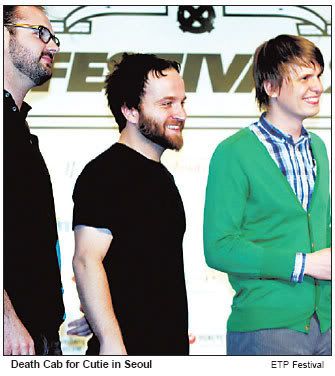
Summertime in Seoul, as in most cities, is a great time for concerts and festivals. Seo Tae-ji's 2008 ETP Festival didn't disappoint; a wide range of rock acts were brought to Seoul. On the same day, there was Marilyn Manson, one of PETA's 2008 Worst Dressed, on the same stage as the PETA-friendly band, Death Cab for Cutie. For this band, which has been on tour to promote their latest album, "Narrow Stairs," such a study in contrasts isn't new.

They also played at this year's Pemberton Festival in British Columbia, Canada, which featured acts from Coldplay to Jay-Z.

After consistently recording and touring for over 10 years, Death Cab has finally reached rock-star status.

Before their show in Korea, I was lucky enough to get the chance to sit down and speak with two members of the band, Jason McGerr and Nick Harmer. The group took its name from a satirical song of the same name by the British Bonzo Dog Doo-Dah Band.

Death Cab started in Seattle over 10 years ago. Because I've been abroad for most of that time, I missed their rise to fame, until I ran across a video of theirs on YouTube and put it on my blog. I also missed the OC phenomenon in which Seth Cohen, one of the main characters, named Death Cab for Cutie as his favorite band. The OC featured the band's songs, and eventually the band appeared on the show.

When I asked them to describe their music, Harmer said, "At the core of our music, I guess, we're just kind of a rock band. We're just playing melodic songs. There is really nothing too overtly aggressive about the music that we play. I think that the themes of our music tend to be around relationships and the interactions between people and the journey that happens as you get older and figure those things out.

"I'd say that we're a little bit more intellectual than not, at times. I guess the hardest thing is to capture what exactly you sound like. We've been really fortunate to see our audience grow over the years since we started 11 years ago."

McGerr added that he sees Death Cab as a career band. He explained that the guys in the band have known each other for 13 years. "And, as much as we've been placed with certain lifestyles or television shows, we've still been that career band that spans beyond those things. It doesn't seem to be slowing down, and I think we're going to continue to do it as long as it makes sense," he said.

Harmer and McGerr played together in a band for three years before joining Death Cab. McGerr mentioned how "the Pacific Northwest is, in general, is a very small music community. We would be in other projects, passing in the night, playing the same shows and venues together, and it was only a matter of time before there was appropriate timing and our schedules lined up."

After their show in Seoul, the band immediately headed to Australia for a few concerts. While they were there, they also helped MySpace TV Australia launch their online TV channel by playing an online concert. Harmer explained: "It's definitely for Australia. Australian MySpace is just getting started in a lot of ways, so our connection, and the reason we're doing it, is mainly for the Australian fans.

"It will probably be available on MySpace worldwide because that's how MySpace is." That led me to ask them a question about Death Cab telling their fans to download music when they signed with Atlantic Records in 2004. "I've always encouraged downloading. I've never encouraged stealing, and I think there is a difference. A label sells albums.

We live in a world now where everyone is using the computer to discover music and to share music. That's an integral part of any band's career, any musician's career or any entertainer's career," said Nick. "You can't really ignore it. The internet has been invaluable in helping us grow and helping spread the word of our band."

The band also has blogs on their website, and both McGerr and Harmer admit that they've not really been able to keep them current.

McGerr adds, "We've been fortunate enough to be savvy enough to understand how important it is. But, for us, we're fortunate that we became a band before all that mattered. We actually had to work hard before anyone found out about who we were. We needed to physically drive across the country for someone to hear about the band. One writer called us a "pre-blog" band. I understand. I totally get that. You can have so much notoriety with a click of a button, but do you have staying power?"

However, for their autumn tour, Harmer said he'll use try to use Twitter for updates. "Twittering would be a lot easier because I can just do it when I can do it." That way, fans can keep up with what this hardworking career band is up to next.

You can find clips from Death Cab's Australia concert at my blog: expatjane.blogspot.com

For more information on Death Cab, see their website: deathcabforcutie.com, and their MySpace page: myspace.com/deathcabforcutie


Here is an Adobe Acrobat version of the file:


Read More...

Sphere: Related Content